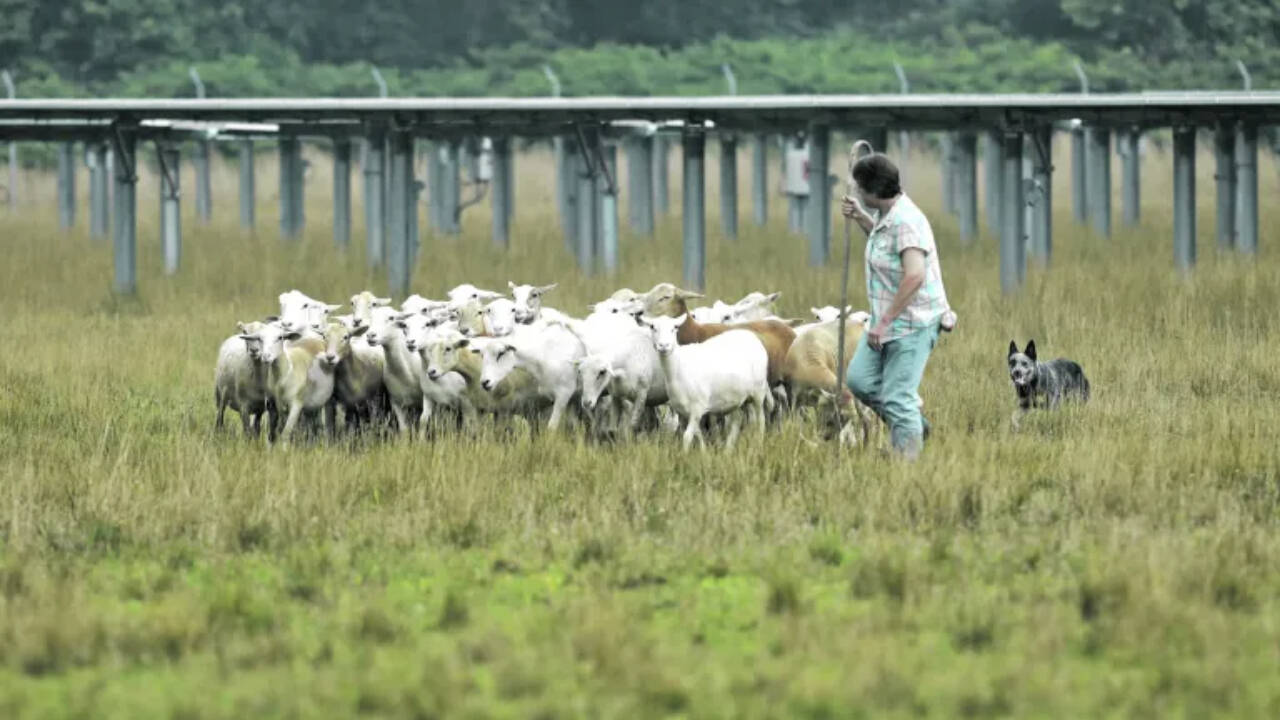
Most people look at a massive solar field and see panels, metal racks, and rows of electronics baking under the sun. Back in 2013, a New Jersey teacher named Julie Bishop looked at that same setup and saw an empty buffet for livestock. Workers were spending grueling hours mowing weeds and clearing brush around fragile electrical infrastructure. Bishop asked a simple question: why not let sheep handle the job?
That single observation sparked Solar Sheep LLC, transforming a modest six-acre farm in Newfield, New Jersey, into a thriving agricultural and clean-energy operation. By 2021, her initial test run of 50 sheep grazing 15 acres ballooned into a 450-strong flock managing 85 acres of solar arrays. What started as an unorthodox backyard experiment turned into a blueprint for modern dual-use land management.
Why Mowers Are Losing to Livestock on Solar Farms
Traditional solar vegetation management relies on heavy machinery, chemical herbicides, and human crews wielding weed-whackers. It's expensive, noisy, and risky. A stray rock flung from a lawnmower can shatter a multi-thousand-dollar photovoltaic panel in a split second.
Sheep solve that problem naturally. They eat the weeds right down to the ground, squeeze into tight spots beneath low-hanging panels where mowers can't reach, and fertilize the soil as they go. It's cheap, efficient, and keeps the carbon footprint low.
Running livestock inside an industrial power plant isn't as simple as opening a gate and walking away. Solar sites are packed with electrical conduit, cable trays, and expensive hardware. If animals chew on wires or rub against sensitive equipment, the financial fallout is massive. Solar grazing requires intense logistical planning, strict rotational schedules, and specialized farm management.
The Logistics of Running Sheep on Solar Arrays
Bishop didn't just dump animals into a fenced yard and hope for the best. Managing a utility-scale solar flock demands military-grade organization.
Portable fencing is the backbone of the operation. By dividing a massive solar array into smaller, manageable paddocks, grazers can rotate the flock through specific zones. The sheep clear one section completely before moving to the next. On smaller or awkwardly designed sites where temporary fencing isn't practical, handlers rely strategically on water and mineral stations to pull the animals toward overgrown patches.
Transporting the flock requires heavy hauling. Bishop relies on a 24-foot stock trailer capable of carrying about 50 sheep at a time. Her Australian Cattle Dog, Mandy, does the heavy lifting on the ground, gathering the flock and spotting strays during high-stakes site transitions.
Not every sheep makes the cut for solar duty. The working flock consists primarily of mature yearlings and ewes. The younger lambs stay back at the main farm in Newfield, where Bishop can monitor their health and growth without interference. She raises Katahdin sheep, a breed known for parasite resistance and adaptability, timing the lambing season for January and February. Those lambs are eventually sold for breeding stock, pets, or meat, diversifying revenue streams well beyond simple vegetation contracts.
Scaling Up for the Future of Agrivoltaics
The success of small-scale solar grazing has caught the attention of major energy developers. Bishop's expanding footprint led to discussions and planning for a massive, purpose-built 700-acre utility-scale solar facility designed specifically with livestock grazing in mind.
This upcoming infrastructure includes dedicated lambing barns, heavy-duty feed storage, and reliable water and electricity hookups on-site. Instead of trucking animals back and forth between temporary gigs, sheep can live and work on the property year-round, scaling the overall operation toward a thousand head of cattle—or rather, sheep.
Of course, growth brings headaches. Moving semi-trucks and heavy stock trailers through industrial gates designed for service vans tests even the most patient driver. Cable trays and uneven grading make navigating utility corridors tedious.
Joining a Broader Agricultural Movement
Scaling a business like this can feel isolating when you are charting unfamiliar territory. That is why getting involved with industry groups matters. Bishop joined the American Solar Grazing Association, eventually stepping up as a board advisor. Sharing knowledge with other farmers facing identical regulatory hurdles, insurance requirements, and animal health challenges helps turn a quirky niche industry into a legitimate, scalable commercial sector.
When agriculture and renewable energy share the same dirt, everyone wins. The solar company slashes its maintenance budget, the sheep get a endless supply of fresh forage, and rural landowners find a way to keep their acreage productive.
Stop thinking of energy production and farming as competing industries. The future belongs to people smart enough to put wool to work beneath the panels.