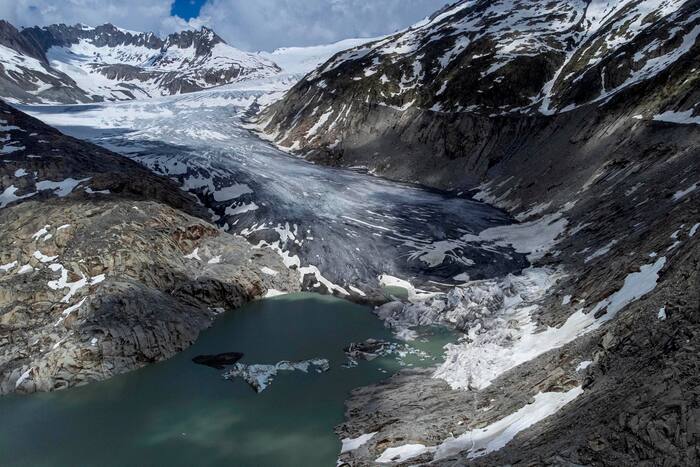
The Alps are bleeding ice, and nobody can pretend it's a distant problem anymore. Swiss glaciers just bled over 5% of their total remaining volume in a single year. That ranks as the second-worst annual percentage drop ever recorded, right behind the catastrophic melt of 2022.
If you think this only matters to mountain climbers or skiers, you're missing the bigger picture. Switzerland acts as the water tower of Europe. When its ice disappears, the consequences ripple across entire nations, threatening drinking water supplies, agriculture, and hydroelectric power generation on a massive scale.
The Brutal Math Behind the 2026 Melt
Let's look at the numbers. According to data from the GLAMOS Swiss glacier monitoring service and the Swiss Academy of Sciences, Swiss glaciers lost 5.5% of their ice volume over the past year.
That sounds abstract until you look at absolute volume. Over the last five years alone, Switzerland's ice reserves dropped by nearly a fifth. The total ice volume remaining today sits at roughly a third of what it was back in 2003.
When you have less ice overall, every hot summer packs a much heavier relative punch. Matthias Huss, who heads GLAMOS, points out the stark reality of the situation. The winter snow cover—which usually acts as a protective blanket and builds fresh ice reserves at high altitudes—failed to show up in sufficient amounts. Without that armor, bare ice absorbed relentless summer heat waves, shrinking individual glaciers by up to 10 meters on their tongues alone.
Why Winter Snow Failed to Save the Alps
Winter snow is the lifeblood of a glacier. It does two critical jobs. First, it reflects sunlight and insulates the older ice underneath. Second, high-elevation snow transforms into new ice over time, replenishing what melts away.
This past winter wrecked that cycle. Low snowfall combined with intense, early-season heat waves meant the protective layer vanished weeks ahead of schedule. Once the bare ice was exposed to the summer sun, the countdown clock sped up dramatically.
Scientists tracked the damage by fanning out across legendary sites like the Allalin, Clarident, Rhone, and Aletsch glaciers—the largest in the Alps. They dumped red dye into raging meltwater streams to measure runoff speed and map the growing crevices tearing through the ice fields. The results confirmed everyone's worst fears: historic landmarks are disappearing in real time.
The Ripple Effect Across Europe
Water doesn't just vanish; it rushes down the mountains and creates immediate crises. From July to September alone, Swiss glaciers shed 2.2 trillion liters of water. That equals roughly 581 billion gallons—enough to cover the annual water consumption of Switzerland's 9.1 million residents four times over.
While extra water sounds fine on paper, it brings severe systemic risks. Switzerland relies on hydropower for more than half of its electricity. Erratic melting schedules disrupt energy planning.
Beyond Switzerland's borders, these shrinking ice caps threaten Europe's major river arteries. The Rhine, the Rhone, the Danube, and the Po all depend on steady seasonal meltwater to maintain flow during dry summer months. When the glaciers are gone, those rivers will run dangerously low. Ecosystems will collapse, cargo shipping lanes will close, and crop irrigation will fail.
Stopping the Blame Game
We aren't watching a natural cycle play out. Matthias Huss puts it bluntly: the warming driving this crisis is tied directly to human activity. Without greenhouse gas emissions, the current rate of atmospheric warming wouldn't exist.
The glaciers are screaming a warning that echoes far beyond the Alps. Similar dramatic retreats are playing out in Greenland, Antarctica, and the Himalayas, where destabilized slopes recently triggered catastrophic flooding in places like Nepal.
You can't negotiate with physics. If greenhouse gas emissions keep climbing, alpine glaciers will disappear entirely by the second half of this century. Protecting what's left requires immediate, aggressive emissions cuts rather than delayed policy targets. Pay attention to the mountains, because when the ice runs out, the rest of the continent follows.