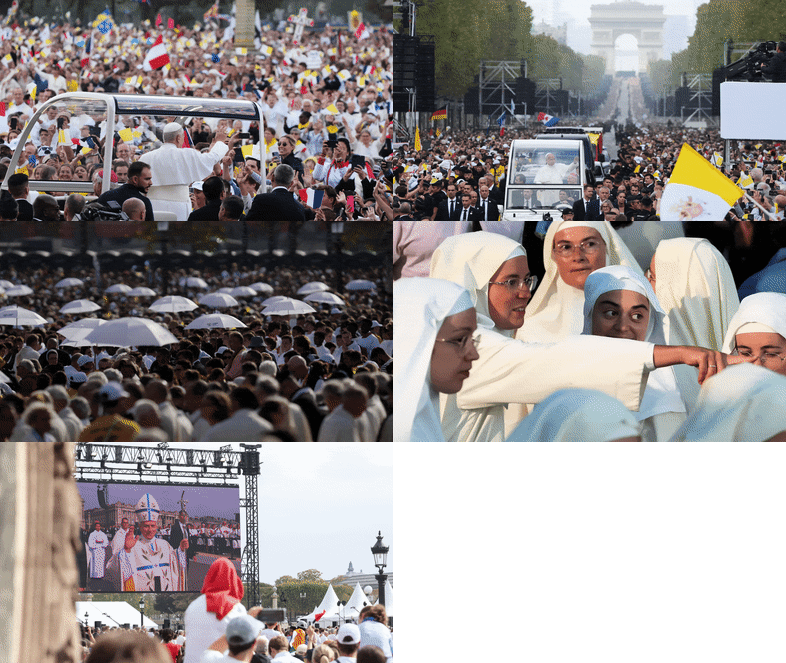
Crowds lined the Champs-Elysees from the Place de la Concorde to the Arc de Triomphe, chanting for Pope Leo as an open-top Popemobile inched forward. Roughly 800,000 people gathered for this outdoor Mass in Paris, marking the single largest event of his high-stakes French tour.
If you look at France strictly through the lens of its staunchly secular constitution—enshrined back in 1905—mass religious gatherings of this scale feel jarring. Yet, people arrived well before sunrise. They pressed against security barriers, waved yellow and white Vatican flags, and craned their necks for a glimpse.
Why are massive crowds turning out for Pope Leo in a country where religious affiliation has plummeted? Let's break down what's actually happening on the ground during this tour.
The Reality of Faith in Modern France
France isn't a heavily practicing Catholic nation anymore. Official numbers from the national statistics agency, INSEE, show that only 25 percent of French people aged 18 to 49 identify as Catholic. That number dropped sharply from 43 percent just a decade prior.
Despite those stats, the Catholic Church in France has seen pockets of unexpected growth. The French Bishops’ Conference noted a record 21,000 adult baptisms last Easter.
Pope Leo addressed this directly during a visit with newly baptised Catholics at the Catholic University of Paris ahead of the massive central Paris Mass. He warned the local church not to be naively optimistic about the recent spike in adherents.
"We must recognise, welcome and protect the small flame that the Holy Spirit has kindled in the darkness of the night," Leo told the gathering. He wants realism, not hype.
Addressing the Heavy Issues
Pope Leo isn't just touring France to wave at crowds and deliver standard sermons. This four-day, three-city trip carries the heavy burden of repairing the church's public standing after devastating abuse scandals shocked the nation.
Following his massive event in Paris, the itinerary moves straight to Lourdes, home to a prominent Catholic shrine. There, he is scheduled to meet privately with seven French victims of clerical abuse. It's a critical stop. Without addressing these systemic failures directly, public outreach rings hollow.
Beyond internal church reform, Leo used his platform to critique global leadership. In a speech at UNESCO headquarters in Paris, he warned that multilateral groups like the United Nations are in deep crisis. He also doubled down on his warnings regarding rapid technological advances, telling French leaders that unchecked artificial intelligence risks creating a "paradise of machines" that takes control of human life.
What the Crowds Are Looking For
Standing in the Paris crowd with his wife and four young children, 36-year-old Pierre-Marie Estienne summed up the mood of many attendees. He pointed out that modern society is steeped in materialism. People feel an underlying emptiness, and they're searching for an anchor.
During his sermon at the Place de la Concorde, Pope Leo hit that exact note.
"Only God can fill the emptiness within us," he told the masses.
Political figures took notice of the immense cultural pull, too. Attendees at the Paris Mass included Brigitte Macron, wife of President Emmanuel Macron, alongside far-right leader Marine Le Pen, Prime Minister Sebastien Lecornu, and LVMH billionaire chairman Bernard Arnault.
When a religious leader can draw nearly a million people to the most famous avenue in Paris while national leaders watch from the pews, it proves that traditional institutions still hold massive sway during times of cultural anxiety. Whether that energy translates into long-term renewal for French parishes remains to be seen.
Take a close look at how secular nations interact with ancient traditions. Pay attention to how leadership changes when communities search for stability amidst rapid technological and political shifts.