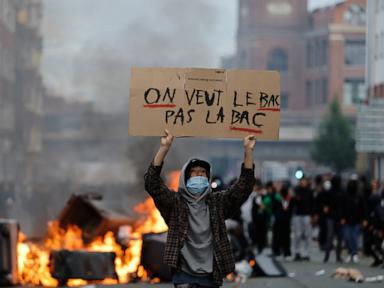
When high school students start locking down campuses and setting fires in the streets, governments pay attention. France is once again facing a massive wave of student unrest that caught officials completely off guard. Prime Minister Sébastien Lecornu didn't hesitate. He called an immediate crisis meeting and ordered cabinet ministers to cancel all official travel to deal with the escalating chaos.
These demonstrations didn't materialize out of nowhere. What started last week as isolated walkouts across Paris-region schools has snowballed into a nationwide movement. Police have already arrested hundreds of people amid violent clashes, with dozens of injuries reported on both sides. Tear gas, thrown projectiles, and police riot-control tools are becoming standard daily fixtures outside French educational institutions.
What Triggered the French Student Protests
If you look past the burning garbage bins and police blockades, the core complaints are remarkably grounded. Students are venting against severely under-resourced schools, crumbling infrastructure, and grueling schedules that stretch from eight in the morning until six at night.
As one Paris high school student bluntly put it, older generations expect teenagers to sit in classrooms all day without considering the heavy mental toll it takes. Combine those daily pressures with broader economic anxiety and inflation biting hard across France, and you have a powder keg ready to blow.
Education Minister Edouard Geffray has faced mounting pressure as the situation deteriorates. Things escalated so rapidly that officials reported a school actually being set on fire, with staff members reportedly doused with gasoline during the chaos. In response, the government has authorized remote learning where blockades make physical attendance impossible.
The Political Fallout and Impending Elections
Timing is everything in politics, and these protests are hitting Paris at the worst possible moment. France is hurtling toward a high-stakes presidential election next May to replace President Emmanuel Macron, who is constitutionally barred from running for a third consecutive term.
Opposition figures are already capitalizing on the unrest. Far-left presidential hopeful Jean-Luc Mélenchon has fiercely denounced the government's response as heavy-handed and repressive. Critics, meanwhile, accuse Mélenchon's allies of pouring fuel on the fire and exploiting teenagers to score cheap political points ahead of the ballot box.
Marine Le Pen's party is also watching closely, currently leading in several polls as public frustration with the ruling administration mounts. When young people take to the streets over basic school conditions, it rarely stays contained to education policy. It quickly becomes a referendum on whoever is sitting in power.
Where Things Stand Now
The government is walking a tightrope. Crack down too hard with police forces, and they risk triggering memories of historic French uprisings that spiraled out of control. Do too little, and the blockades will paralyze the education system entirely.
Prime Minister Lecornu's decision to freeze ministerial travel signals that Paris views this as a top-tier security and political threat. With weeks before the political landscape shifts further toward election season, the pressure on the current administration isn't easing up anytime soon.