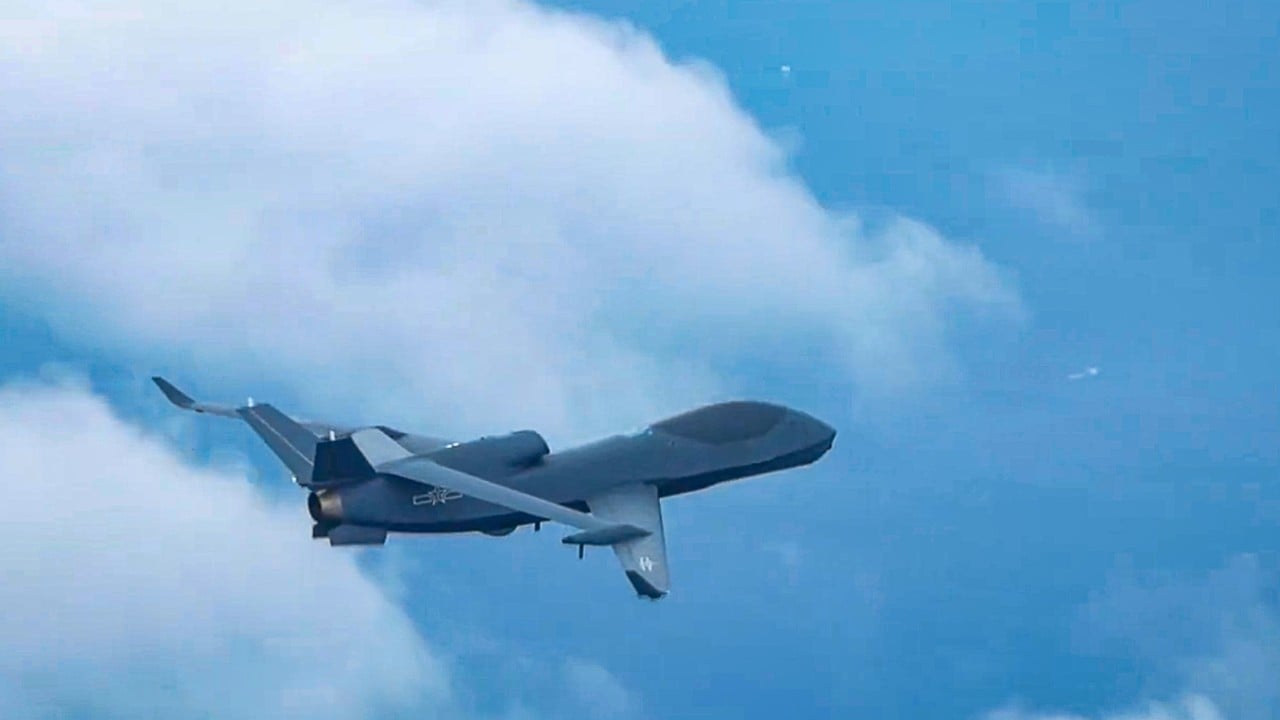
Beijing just moved a massive tactical chess piece across the South China Sea. If you haven't been watching the skies near Scarborough Shoal, you missed the operational debut of the WZ 7 Soaring Dragon drone in that specific flashpoint. It's loud, it's persistent, and it signals a permanent shift in regional surveillance.
Look, military observers often miss the quiet details because they are too busy tracking aircraft carriers and destroyer sail-bys. This isn't just about a new aircraft showing up in a disputed zone. It is about twenty-four-hour eyes in the sky that can stay aloft for ten hours straight while feeding high-resolution data back to mainland command centers.
What the WZ 7 Actually Brings to the Table
You've probably seen pictures of this high-altitude reconnaissance beast. It features an unusual joined-wing box design that looks straight out of a science fiction film, but the engineering is brutally practical. That configuration gives the airframe incredible aerodynamic efficiency at high altitudes, allowing it to loiter far longer than traditional turbojet surveillance planes.
When Beijing deploys the WZ 7 Soaring Dragon near a hot spot like Scarborough Shoal, they aren't just taking pictures. They are mapping radar emitters, tracking naval traffic from the Philippines and other claimant states, and building a real-time targeting picture.
Most people don't realize how much the game has changed from satellite imagery to persistent drone surveillance. Satellites pass over a specific grid coordinate at predictable intervals. You can hide under a cloud cover or reposition ships during the blind spots. The WZ 7 doesn't give you that luxury. It sits up there, staring down, collecting electronic intelligence without risking a pilot's life.
The Scarborough Shoal Strategic Calculus
Scarborough Shoal is basically a triangular chain of reefs and rocks sitting roughly 120 nautical miles off the coast of Luzon. It is tiny. It is barren. Yet it sits at the absolute center of Manila's exclusive economic zone and Beijing's sprawling nine-dash line claims.
Why fly a high-end strategic drone there now? Pressure.
Regional dynamics are shifting. Joint patrols between Manila and external partners like the United States, Japan, and Australia have ramped up significantly over the past two years. Beijing sees those exercises as an encirclement strategy. By parking the WZ 7 overhead, they are sending a direct message about domain awareness. They want everyone in the region to know that every maneuver is tracked, logged, and analyzed.
I've talked to defense analysts who spent years tracking South China Sea escalations, and the consensus is stark. This deployment isn't a temporary drill. It is the new baseline.
The Technology Gap Nobody Wants to Discuss
Let's talk about the hardware for a second. The WZ 7 is often compared to the American RQ 4 Global Hawk. While they serve similar strategic roles, the operational doctrines differ wildly.
The US relies heavily on a distributed network of allies and sprawling airbases to push high-altitude drones into contested regions. Beijing has built an island-base network across the South China Sea that acts as staging grounds, extending the operational reach of airframes like the WZ 7 without needing permission from foreign hosts.
Here is what really matters:
- Endurance: Over ten hours of continuous flight time per sortie.
- Altitude: Operating well above 60,000 feet, staying clear of most standard air defense interceptors.
- Sensors: Advanced synthetic aperture radar and electro-optical payloads designed to spot small patrol boats in heavy seas.
When you combine that altitude with modern data links, you get a system that bridges the gap between tactical reconnaissance and strategic command.
How This Impacts Regional Security Moving Forward
If you are tracking maritime trade routes or military movements in Southeast Asia, you have to throw out the old playbooks. Low-cost drones changed the tactical war in Eastern Europe, but high-altitude surveillance monsters like the WZ 7 are reshaping the great power competition in maritime Asia.
Expect Manila and its security partners to accelerate their own counter-surveillance and electronic warfare capabilities. You can't shoot down a drone flying at 60,000 feet without triggering an outright war, so the response has to happen in the electromagnetic spectrum. Expect more jamming, more signal spoofing, and a quiet, invisible war waged over the airwaves.
Keep your eyes on the electronic data. The visible ships are only half the story.