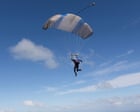
Most people assume emergency medical help arrives in an ambulance, screaming down a paved highway. Sometimes, it drops out of the sky.
That is exactly what happened on a Sunday afternoon near East Troy, Wisconsin, when a routine recreational skydiving flight turned into an airborne rescue mission. A single-engine Beechcraft 35-A33 Debonair banked sharply, vanished behind a thick line of trees, and slammed into a cornfield. On board the jump plane hovering above, veteran skydivers didn't just watch the disaster unfold. They reacted with the precision of trained paramedics, deploying straight into the wreckage before ground crews could even navigate the rural grid.
The Split-Second Decision That Changed Everything
John Bechtel and Kevin Flynn were sitting in the Skydive Milwaukee aircraft, running through standard preparation for an afternoon jump. They saw the small plane go down.
"Did we just see a plane crash?" Bechtel recalled asking his fellow jumpers.
They didn't hesitate. Working alongside the pilot, Jonah Johnston, who radioed air traffic control with an offer to drop a team directly over the site, Bechtel and his colleagues made a split-second call. They suited up, coordinated their exit, and jumped into an emergency scenario.
When you look at rural aviation accidents, time is everything. Ground ambulances face massive hurdles when an aircraft goes down in dense crops or remote terrain. Standard navigation requires navigating dirt tracks, opening gates, and searching blindly. These skydivers bypassed all of that. They hit the drop zone, landed feet from the disaster area, and went straight to work.
Navigating the Cornfield Maze
Hitting the ground is only half the battle when you're jumping into unfamiliar territory. Flynn described landing in a tall cornfield where visibility was nearly zero. You can't see a downed aircraft when stalks tower over your head.
To locate the wreckage, Flynn used a method akin to the childhood game Marco Polo, shouting out across the field until a voice answered back from the crushed metal.
That human response cut through the chaos. Once they reached the aircraft, their dual backgrounds as paramedics kicked in instantly. One jumper immediately tended to a female passenger suffering from a severe head injury, stabilizing her condition and monitoring her vitals while waiting for emergency medical technicians to arrive via ambulance.
Three passengers were ultimately transported to local hospitals, while a fourth received treatment at the scene. Miraculously, despite the severity of the crash—which left the 1961-built vintage aircraft upright with a detached wing—no fatalities were reported. All four occupants are expected to survive.
Why This Kind of Preparedness Matters
We talk a lot about being in the right place at the right time, but true readiness requires skill when luck finally strikes. The intersection of recreational skydiving and emergency medical training is rarer than most think, but it highlights a broader truth about community-driven rescue efforts.
The National Transportation Safety Board (NTSB) launched an immediate investigation into the cause of the crash, sending an investigator to comb through the wreckage. While federal authorities sort out engine failures, flight paths, and mechanical logs, the immediate takeaway isn't about aviation safety protocols alone. It is about human agency.
If the jump plane had left five minutes earlier, those skydivers would have been on the ground, miles away from the flight path. If they had departed fifteen minutes later, the window to provide life-saving field triage would have slammed shut before help could navigate the rural roads.
Sometimes, the cavalry doesn't wait for a dispatch call. They jump straight out of an airplane and walk right into the tall grass to save a life.