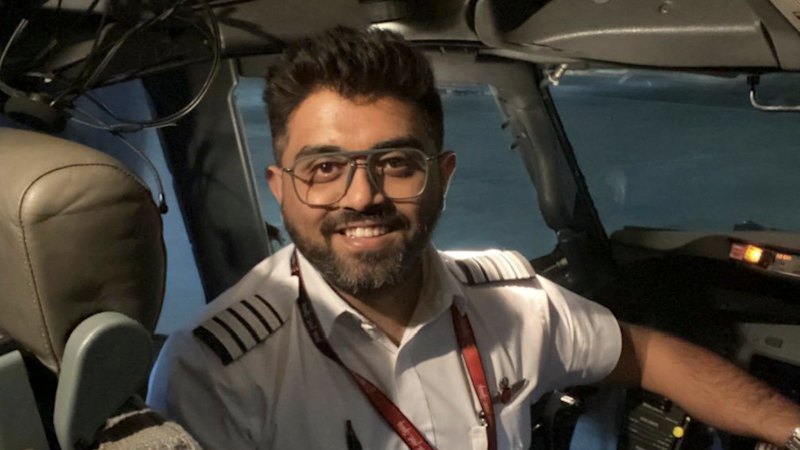
Commercial aviation relies on redundancy, but nobody programs training manuals for a knife fight at 30,000 feet. When flydubai flight FZ1073 plunged nearly 14,000 feet in less than thirty seconds on a route from the United Arab Emirates to Israel, 174 passengers stepped over the edge of an unthinkable catastrophe. The chaos inside the cockpit didn't come from a mechanical failure or engine fire. It stemmed from a bloody, violent confrontation between the flight crew, leaving Captain Smit Machchhar critically injured yet conscious enough to perform the one action that kept the plane in the air.
Most people assume modern commercial autopilots make cockpit security foolproof against internal threats. They aren't. When a co-pilot allegedly turns rogue and launches a sudden assault, the physical barrier of the cockpit door cuts both ways. Captain Smit Machchhar found himself bleeding on the flight deck floor, stabbed and fighting for his life while the aircraft spiraled downward. His decisive choice to manually click the cockpit door release button while covered in blood allowed passengers, crew members, and two off-duty pilots traveling as passengers to flood the flight deck. They overpowered the attacker and stabilized the jet before landing safely in Tabuk, Saudi Arabia. Also making headlines in this space: How The Destruction Of An Indian Pharma Plant In Ukraine Changes The War.
Anatomy of a Midair Crisis
Commercial airliners are engineered to withstand structural fatigue, bird strikes, and severe weather turbulence. They are not built for hand-to-hand combat inside a confined flight deck. When flight FZ1073 began its terrifying descent, the sudden loss of altitude generated immediate panic in the cabin.
The struggle inside the cockpit happened in seconds. Captain Machchhar suffered knife wounds during the altercation, yet his physical endurance under extreme trauma defied ordinary limits. Prime Minister Benjamin Netanyahu and Indian Prime Minister Narendra Modi publicly hailed Machchhar for his unwavering resolve. Leaders from multiple nations recognized that if the captain had lost consciousness entirely before unlocking the security barrier, the aircraft would have hit the ground with zero chance of recovery. Further insights regarding the matter are explored by TIME.
The Heroism of Passengers and Off-Duty Crew
Stopping a midair security threat requires extraordinary coordination when you're hurtling through the stratosphere at high speeds. Passengers didn't just panic; they reacted. Travelers rushed forward to assist the cabin crew once the cockpit door popped open.
Among the individuals who made the difference were off-duty pilots on board the aircraft. Aviation experts pointed out that while commercial pilots undergo rigorous safety drills and incapacitation scenarios, physical knife attacks are entirely outside standard simulator training. Two off-duty aviators—including a New Zealander—stepped up to take control of the flight instruments, navigating the damaged aircraft away from densely populated areas and executing an emergency landing in Tabuk.
What Aviation Authorities Are Investigating Now
The incident immediately triggered heavy operational fallout across regional carriers. Flydubai suspended flights to and from Israel while international aviation bodies launched exhaustive reviews. Investigators are examining the background of the co-pilot, who was detained by Saudi authorities for interrogation.
Questions remain regarding psychological screening protocols and cockpit access controls. Airlines rely heavily on mental health self-reporting and periodic check-ins, but experts acknowledge that detecting internal malicious intent remains one of aviation's hardest security challenges.
Captain Machchhar underwent emergency surgery at a hospital in Tabuk and was listed in stable condition. His training at Mainland Air in New Zealand years prior and his long tenure with SpiceJet before joining flydubai forged an instinctual resilience that ultimately kept 174 people alive. Aviation safety will change because of flight FZ1073, but the immediate takeaway is simple. Technology matters, but human grit still stops disasters from happening.